
Xuan Zang is not a familiar name in the school history books so the first time I heard it, it rang a bell. I was intrigued to find more because all of facts related to Buddha in Nalanda and vicinity were cross referenced with Xuan Zang’s travelogue.
Being a traveler myself and having experienced many cultures I wanted to know more about the Chinese scholar who travelled to India via the silk route. My first detailed encounter with Xuan Zang was these travel guide maps that were developed as a part of the Explore Rural India project, when Deepak (my co-author) asked me to edit some of the passages.
 XuanZang traveled through various important sites related to Buddha and Buddha’s teachings several centuries after Buddha’s parinirvana and wrote extensively about them in his travelogue. After the 12 century Turk invasion when all the visible sign of Buddhism were obliterated from Magadha region, there was no way to even confirm that the roots of Buddhism lay buried deep in this landscape. The original structures were either buried in layers of soil or surrounded with local legends, the bricks and pillars were used to support new structure and the teachings lived through festivals and traditions among the people here. It was then Xuanzang’s travelogue that came to the rescue of the early Orientalists who tried to solve this puzzle.
Soon after I was introduced to XuanZang’s history, I got the opportunity to tour the sites of Nalanda that were mentioned in travel brochure and I was thrilled to see what was left and enthralled to imagine what must have been. Deepak and I discussed the possibilities and ways to share this heritage and knowledge with those who might be interested but are unaware. Out of the continued discussions were generated many ideas about how the information that we have can be shared, preserved and most important of all be beneficial to the community that lives with these treasures.
Some of these ideas have already sown the seeds and others are still in the making; the Nalanda (Nalanda-insatiable in offerings & Nalanda on the move) blogs were our way of sharing the history and our progress while keeping tabs on our goals and ultimate destination.

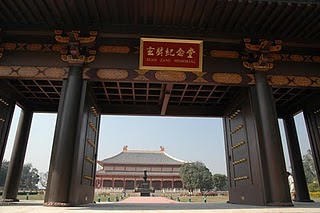 Once the idea of the book sunk in, Deepak came up with the basic set up about how to best share the complete story without losing the interest of the reader and segregated the information into chapters and visuals. While Deepak poured over the facts about Xuan Zang’s journey, the path he took and the time and hurdles he passed and other important events of the journey, I worked on the details about Xuanzang’s life history, his motivation to travel to India and then the reasons he chose to write his travelogue. During this time, Dr. Panth who is the director of Nav Nalanda Mahavihar acted as our anchor; he made sure I don’t take many writers’ liberties over the hard core fact and closely guided Deepak as he developed the exact route maps and the timelines. We discussed the Architectural details of the structure and how it has been inspired from Chinese architecture which in turn in some situations was an adaptation of Indian structures of the time. We all worked in close collaboration and went around circles many times and churned out a concise book about Xuanzang, who he was, what inspired him and how his contributions added to the spread to Buddhism, not only in China but other South East Asian countries including India. The route maps in the book are one a kind and have been created with great precision and thorough research. Although working on a project like this with our team, two members that are 8000 miles and 11 hours apart and the third one who bares the responsibility of an entire university and travels frequently, was very challenging but getting the final product to print was whole another saga. There were as many iteration if not more for the format of the book as there were for the original content, but in the end it is what we wanted, a book that is within reach of every visitor that come to see Xuanzang Memorial or perhaps finds a copy and is inspired to visit and pay a tribute.
While on the excursion to Nalanda, I visited the Xuanzang Memorial and Museum, which is built a short distance away from the Nalanda University ruins. The building and its inspiration both come with a very interesting history, and I (along with the rest of the team) get to share it with you.

I am excited and humbled as I share this book with you - 'Xuanzang, footsteps that time cannot erase'. A book that began with a casual conversation and was carried forth with much enthusiasm and passion, to explain to the visitors of Xuanzang Museum who ‘Xuanzang’ really was and how much he contributed to our history.
Once the idea of the book sunk in, Deepak came up with the basic set up about how to best share the complete story without losing the interest of the reader and segregated the information into chapters and visuals. While Deepak poured over the facts about Xuan Zang’s journey, the path he took and the time and hurdles he passed and other important events of the journey, I worked on the details about Xuanzang’s life history, his motivation to travel to India and then the reasons he chose to write his travelogue. During this time, Dr. Panth who is the director of Nav Nalanda Mahavihar acted as our anchor; he made sure I don’t take many writers’ liberties over the hard core fact and closely guided Deepak as he developed the exact route maps and the timelines. We discussed the Architectural details of the structure and how it has been inspired from Chinese architecture which in turn in some situations was an adaptation of Indian structures of the time. We all worked in close collaboration and went around circles many times and churned out a concise book about Xuanzang, who he was, what inspired him and how his contributions added to the spread to Buddhism, not only in China but other South East Asian countries including India. The route maps in the book are one a kind and have been created with great precision and thorough research. Although working on a project like this with our team, two members that are 8000 miles and 11 hours apart and the third one who bares the responsibility of an entire university and travels frequently, was very challenging but getting the final product to print was whole another saga. There were as many iteration if not more for the format of the book as there were for the original content, but in the end it is what we wanted, a book that is within reach of every visitor that come to see Xuanzang Memorial or perhaps finds a copy and is inspired to visit and pay a tribute. 
It was released in a small ceremony by the current honorable Governor of Bihar ‘H E Debonand Konwar’ on the 25th September in Patna, Bihar. In this picture Dr. Panth is with the honorable Governor.


